
Film critic Roger Ebert once said that “each film is only as good as its villain.” It’s one of those observations so obvious in hindsight that it’s a wonder it ever needed saying. But Ebert understood something that many filmmakers still get wrong: a great villain is not a monster. A great villain is a person whose logic, at some terrible, clarifying moment, you find yourself unable to argue with.
The eight characters on this list don’t just happen to be well-written antagonists. They each represent a worldview — a coherent, often devastating critique of the society, the system, or the hero standing across from them. They were wrong in their methods. Some were catastrophically, irredeemably wrong. But in their reasoning? A case could be made. Often is.
That’s what separates a great villain from a forgettable one. Not the costume. Not the body count. The argument.
Amy Dunne (Gone Girl)
Before Amy Dunne does anything that places her firmly in the villain column, she delivers one of the most scalpel-sharp monologues in modern cinema — the “Cool Girl” speech. It is a precise, withering dissection of the performance that women are quietly expected to give in relationships: the easy, unbothered, always-game version of femininity that men idealize and women exhaust themselves trying to maintain.
Amy’s methods are psychopathic. Framing her husband for her own murder, manipulating the media, destroying innocent lives — none of it is defensible. But the diagnosis she gives in those few minutes is so surgically accurate that it turns the audience into unwilling co-conspirators. You know she’s wrong. You understand exactly why she got here.
“Men always say that as the defining compliment, don’t they? She’s a cool girl. Being the Cool Girl means I am a hot, brilliant, funny woman who adores football, poker, dirty jokes…”— Amy Dunne, Gone Girl (2014)
Rosamund Pike’s performance earned her an Oscar nomination for good reason. She plays Amy not as a monster but as someone who decided to stop lying — and chose catastrophically wrong methods to do it. The argument she makes, stripped of its crimes, is one that a generation of women recognized immediately.
The argument: Society demands an exhausting performance of femininity. Amy is wrong in every action she takes. Her critique of gender expectations is not.
Erik Killmonger (Black Panther)
The Marvel Cinematic Universe has produced dozens of antagonists, most of them forgettable. Erik Killmonger is the exception so total that he occasionally overshadows the hero of his own film — and the filmmakers seem to have known it.
Killmonger’s grievance is not invented. He was born in Oakland to a Wakandan prince who was murdered by his own brother — the same brother who would go on to rule the most technologically advanced nation on Earth while the descendants of African slaves suffered through centuries of poverty, violence, and oppression. Killmonger watched his world with eyes that never stopped asking: if Wakanda has all of this, why did they do nothing?
His plan — to weaponize Wakanda’s Vibranium and arm the oppressed across the world — is radical, violent, and would likely cause catastrophic blowback. But the underlying question he poses to T’Challa is one the film cannot dismiss: at what point does non-intervention become complicity? Wakanda chose itself for centuries. Killmonger is what that choice made.
“I’ve waited my whole life for this. The world’s going to start over, and this time we’re in charge.”— Erik Killmonger, Black Panther (2018)
The argument: Powerful nations bear a moral responsibility to the oppressed. Killmonger’s violence is inexcusable. His critique of Wakandan isolationism is so valid that it changes Wakanda’s foreign policy by the end of the film.
Anton Chigurh (No Country for Old Men)
Chigurh is the villain on this list who least resembles a human being — and that is entirely the point. The Coen Brothers constructed him as something closer to a force of nature than a person: unstoppable, without sentiment, operating by a private code of logic so absolute it functions as its own moral system.
His philosophy — that fate is indifferent, that chance governs outcomes no matter how much humans pretend otherwise, that most of the suffering people experience flows directly from the choices they already made — is deeply disturbing precisely because it is not obviously wrong. His coin tosses are not cruelty. They are, in his view, mercy: an acknowledgment that the universe doesn’t care, given physical form.
Javier Bardem won the Oscar for Best Supporting Actor for this performance, and it remains one of the most chilling in cinema history. But what makes Chigurh linger is not his violence. It’s the moment you find yourself unable to construct a clean counterargument to his worldview. The feeling passes. The unease doesn’t.
“What’s the most you ever lost on a coin toss?”— Anton Chigurh, No Country for Old Men (2007)
The argument: Human choices set chains of consequence in motion that cannot be escaped. His methods are monstrous. His philosophy of personal responsibility — stripped of the murders — is something most moral traditions share.
Michael Corleone (The Godfather Trilogy)
Michael Corleone begins as the hero. He is the war hero, the educated one, the son who was supposed to represent the Corleone family’s escape from the world his father built. By the end of the first film, he has arranged the murder of every rival family’s leadership in a single coordinated massacre while standing at a baptism font, renouncing Satan on behalf of his nephew.
The genius of Coppola’s trilogy — and of Al Pacino’s performance across three films — is that Michael is never not making a rational choice. Every step of his descent follows its own cold logic: protect the family, eliminate the threat, secure the future. He is not corrupted by power in the cartoonish sense. He is consumed by a system that rewards exactly his particular mix of intelligence, loyalty, and willingness to act when others hesitate.
The argument Michael makes is not about crime. It’s about legitimacy. His famous observation — that his father’s criminal empire is really no different from the behavior of senators and presidents — is the film’s most politically charged line. And Coppola never really refutes it. He just shows you what it costs.
“My father made him an offer he couldn’t refuse… Luca Brasi held a gun to his head, and my father assured him that either his brains or his signature would be on the contract.”— Michael Corleone, The Godfather (1972)
The argument: Institutional power and criminal power operate by the same rules. Michael’s crimes are unforgivable. His analysis of how power actually works in America remains the sharpest in cinema history.
Hans Landa (Inglourious Basterds)
Tarantino built Hans Landa — the “Jew Hunter” of the SS — as the most intellectually formidable villain he had ever conceived. Christoph Waltz won the Palme d’Or at Cannes, then the Oscar, for a performance in which the most frightening thing about Landa is never his cruelty. It is his charm, his delight, and his suffocating intelligence.
Landa’s argument is the most chilling on this list because it is the argument of pure, amoral competence. He does what he does not because he believes in Nazi ideology — he is at pains to make clear he would work just as happily for the other side — but because he is extraordinarily good at it, and extraordinary competence, in his view, is its own justification. He is the film’s most devastating portrait of what happens when intelligence operates without conscience: not a monster, but something worse — a professional.
His turn at the film’s end, in which he negotiates his own comfortable postwar future with the Allies, is played for dark comedy. But the point is lethal: these men didn’t disappear after the war. They went to work for the winning side. Landa just had the nerve to say it out loud.
“I love rumors! Facts can be so misleading, where rumors, true or false, are often revealing.”— Hans Landa, Inglourious Basterds (2009)
The argument: Institutional evil survives because of intelligent, capable people who choose comfort over conscience. Landa is indefensible. His existence as a character is a case study in how atrocity is staffed.
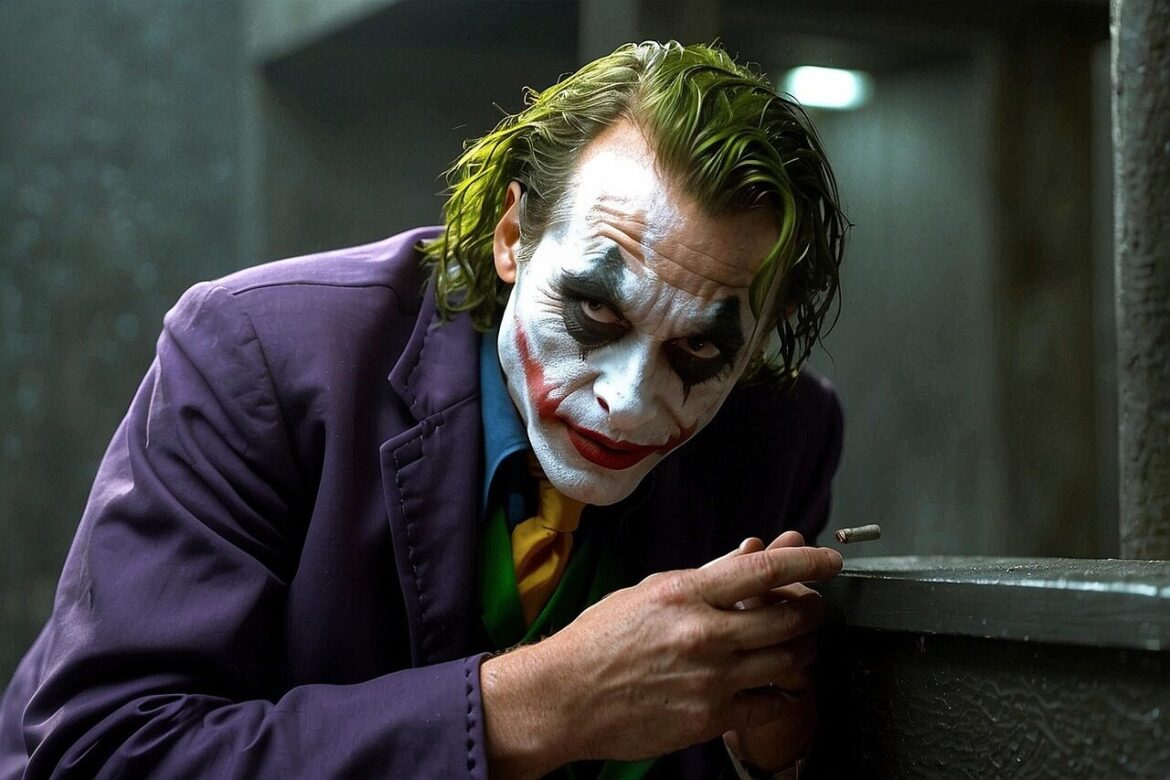
The Joker (The Dark Knight)
Heath Ledger’s Joker is the most analyzed villain of the 21st century, and the reason is simple: he keeps winning the arguments. Not the fights — Batman stops him, eventually. But the debates. Every time the Joker sets up a scenario designed to prove that people will abandon their principles when pushed hard enough, the film squirms before letting the heroes escape.
His fundamental claim — that civilization is one bad day away from chaos, that the social contract is maintained only so long as everyone believes everyone else will maintain it, that order is an agreed-upon fiction sustained by those with power to enforce it — is a serious philosophical position, not a madman’s raving. Thomas Hobbes spent an entire career on versions of it.
What makes Ledger’s performance immortal is that the Joker is never convincingly defeated. Batman physically stops him. But the Joker explicitly says he doesn’t care — he’s already made his point. By the end, Gotham is concealing a lie about its greatest hero to preserve order. The Joker planned for exactly that. He said the system would corrupt itself if you pressed hard enough. He was right.
“You see, their morals, their code — it’s a bad joke. Dropped at the first sign of trouble. They’re only as good as the world allows them to be.”— The Joker, The Dark Knight (2008)
The argument: Social order is maintained by collective belief, not inherent morality. His terrorism is inexcusable. His prediction — that the city would lie to protect the myth of its hero — came true in the same film.
Colonel Kurtz (Apocalypse Now)
Marlon Brando delivered very few lines in Apocalypse Now. He didn’t need to. By the time Willard finally reaches Kurtz deep in the Cambodian jungle, the film has already made the case for him — shown us the napalm strikes, the senseless operations, the generals running a war they have no intention of winning and every intention of administering indefinitely.
Kurtz’s argument is not that war is wrong. His argument is that the Americans are fighting it with one hand tied behind their backs — not out of restraint, but out of hypocrisy. He watched his country drop bombs on villages while requiring paperwork for each engagement. He concluded that the only honest position, the only position consistent with actually winning, was to embrace the horror rather than pretend it doesn’t exist. He is not wrong that the Americans were hypocrites. He is catastrophically wrong about his solution. The distance between those two facts is the entire film.
“We train young men to drop fire on people. But their commanders won’t allow them to write ‘f—‘ on their airplanes because it’s obscene.”— Colonel Kurtz, Apocalypse Now (1979)
Brando — improvising much of his dialogue — gives Kurtz the weight of a man who has not gone mad but has simply followed his government’s logic to its natural endpoint. What disturbs most is not the god-king in the jungle. It is the realization that the institution that produced him never changed.
The argument: Institutional violence cannot be moralized into acceptability. Kurtz became a monster. His critique of American military hypocrisy was the same one a generation of veterans were making at home.
Nurse Ratched & Hannibal Lecter — A Tie
The top slot belongs to two villains, because the best argument for a tie in cinema history is this one: Nurse Ratched and Hannibal Lecter are, at their core, the same villain — an institution wearing a human face — and together they represent the two poles that every great villain occupies.
Louise Fletcher’s Nurse Ratched is arguably the most frightening villain in American film because she never once steps outside the rules. Every act of cruelty she commits is sanctioned, documented, and procedurally correct. She breaks Randle McMurphy not with violence but with the grinding, airless weight of the system she embodies. Her argument — that order must be maintained, that the patients in her care need to be managed, that what she’s doing is for their own good — is the argument of every institution that has ever caused harm while following its own procedures to the letter. The film is one of the great indictments of institutional power in cinema. Ratched is its delivery mechanism.
“If Mr. McMurphy doesn’t like it here, he can always go back to the work farm.”— Nurse Ratched, One Flew Over the Cuckoo’s Nest (1975)
Anthony Hopkins’ Lecter inhabits the other pole entirely. Where Ratched is the system, Lecter is the individual so far outside the system’s reach that he becomes his own system. His famous observation — that rudeness is deeply unsound, and that he eats the rude — is played for horror. But it is also, in its darkest form, an argument about what a society without manners, without genuine civilization, actually produces. He is not wrong that the world is full of cruelty masquerading as normalcy. He simply chose the most monstrous possible response to that observation.
“A census taker once tried to test me. I ate his liver with some fava beans and a nice Chianti.”— Hannibal Lecter, The Silence of the Lambs (1991)
Together, Ratched and Lecter define the limits of the great-villain argument. One is the horror of the group with too much power. The other is the horror of the individual with too much intelligence and too little conscience. Between them, they have framed nearly every compelling villain that came after.
The argument: Power without accountability destroys people (Ratched). Intelligence without conscience destroys people (Lecter). Both arguments are correct. Both characters are irredeemable. That’s what makes them number one.
What the best villains have in common
Every villain on this list shares one quality: they are not evil because the writer needed a bad guy. They are evil because they followed a logic — a real, traceable logic — into a place where most people stop. The argument they make, at its beginning, is usually one you’ve heard before. Sometimes from people you respect. Sometimes from yourself.
That is what Roger Ebert meant. Not that a great villain needs to be scary, or spectacular, or technically impressive. He meant that a great villain needs to be right about something — and wrong about what to do with that truth. The gap between those two things is where the best films in history have always lived.
The heroes we love are the ones who find a different path through the same reality. The villains we can’t forget are the ones who remind us how easy it would have been to take theirs.
Leave a Reply