
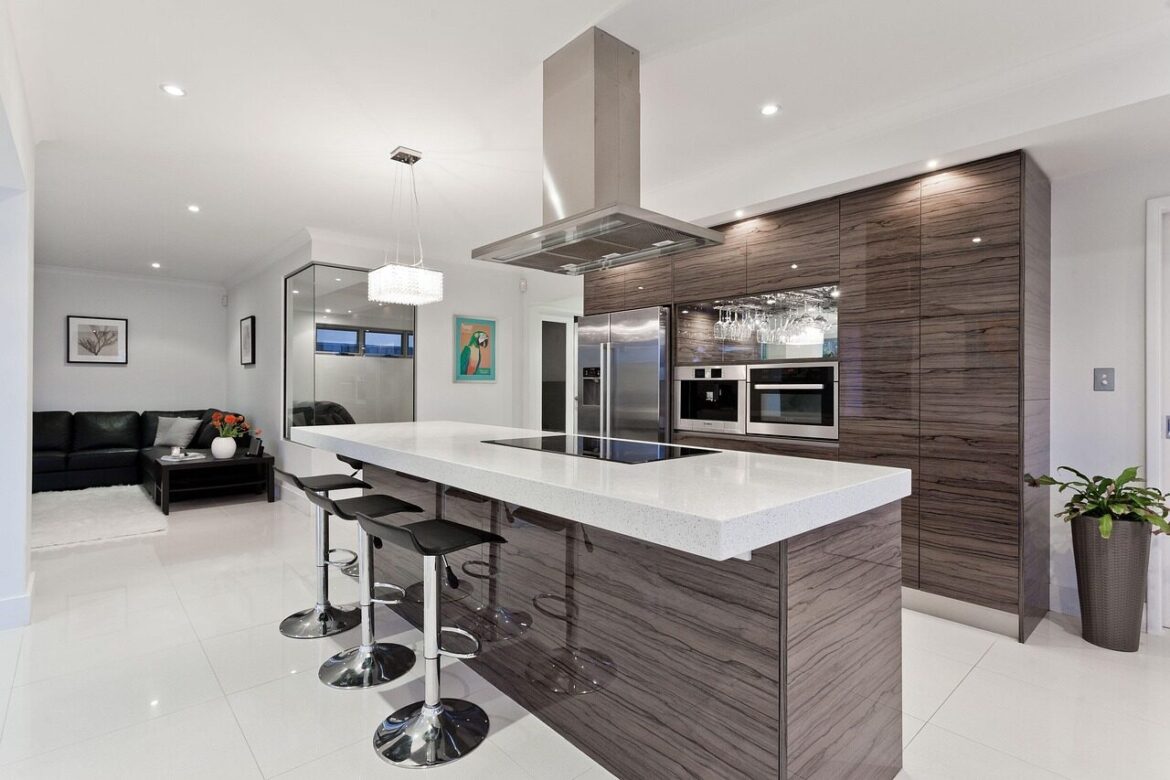
For the last three decades, “Open-Concept” has been the most dominant phrase in residential architecture. Knocking down walls to create a seamless flow between the kitchen, dining, and living areas was marketed as the ultimate lifestyle upgrade—a way to foster connection, maximize light, and make even modest homes feel palatial.
But as the trend became a standard, a team of atmospheric scientists and indoor air quality experts began noticing a disturbing side effect. By removing the physical barriers between where we cook and where we sleep, we have inadvertently turned our entire living environments into “pollution zones.” What was sold as a design revolution is now being reassessed as a significant health oversight.
1. The “Kitchen-to-Couch” Pollution Pipeline
In a traditional home layout, the kitchen was a self-contained room. This wasn’t just for privacy; it acted as a “containment zone.” When you sear a steak or boil pasta, you are releasing a cocktail of pollutants, including Nitrogen Dioxide ($NO_2$), Carbon Monoxide ($CO$), and fine particulate matter known as $PM_{2.5}$.
In an open-concept home, there is no “containment.” Scientists using high-speed laser imaging have tracked how these particles move; without walls, $PM_{2.5}$ clouds migrate from the stove to the living room sofa and into the bedrooms within minutes. In these “barrier-free” environments, the concentration of cooking pollutants in the master bedroom can reach levels that exceed EPA outdoor air quality standards, even hours after the meal is finished.
2. The Invisible Threat of Nitrogen Dioxide
The most concerning discovery involves gas stoves. When gas is burned, it releases Nitrogen Dioxide, a pungent gas that is a known trigger for asthma and respiratory inflammation. In a closed kitchen with a strong exhaust fan, the majority of this gas is vented out.
However, in an open-concept floor plan, the sheer volume of the space makes standard ventilation much less effective. The gas “dilutes” into the larger living area, but it doesn’t disappear. Instead, it lingers at low, persistent levels throughout the entire house. A study published in the International Journal of Environmental Research and Public Health found that children living in homes with gas stoves and open floor plans had a significantly higher risk of respiratory symptoms compared to those in traditional layouts.
3. The “Soft Surface” Sponge Effect
Walls aren’t just barriers; they are surfaces that can be cleaned. In an open-concept home, the “walls” are often replaced by soft furnishings—upholstered sofas, heavy curtains, and area rugs.
Scientists have found that these soft surfaces act as “pollution sponges,” absorbing the microscopic grease and soot particles released during cooking. Over time, these particles undergo a chemical reaction with the fabric, creating “third-hand smoke” equivalents that are re-released into the air every time you sit on the couch or walk across the rug. In a traditional house, the kitchen door kept these “grease-clouds” away from your expensive textiles; in an open-concept home, your furniture is effectively part of the exhaust system.
4. The Noise-Pollution Connection
Air quality isn’t just about what you breathe; it’s about the “sensory environment.” Scientists at the University of Sydney found that the lack of acoustic barriers in open-concept homes leads to “chronic low-level stress.”
The hum of the refrigerator, the roar of the dishwasher, and the sizzle of the pan are no longer confined to the kitchen. In an open space, these sounds bounce off the hard surfaces (granite counters and hardwood floors), raising the “decibel floor” of the home. This constant acoustic clutter prevents the brain from entering a state of deep rest, leading to higher cortisol levels—the very thing “open living” was supposed to reduce.
5. The Return of the “Broken Plan”
The evidence is so compelling that architects are now pivoting toward a new trend: the “Broken Plan.” This design maintains the feeling of openness using glass partitions, pocket doors, and half-walls, but it restores the functional “containment” that our health requires.
By strategically re-introducing barriers, homeowners can finally vent their kitchens properly, protect their air quality, and reclaim the quiet that was lost in the “walls-down” era. The open-concept dream isn’t necessarily dead, but the “barrier-free” experiment has proven that some walls were there for a very good reason.
Leave a Reply